More About AI
by William Lulow
I have written a couple of articles so far, about AI and how it is remaking the world of imagery. In photography, Adobe Photoshop has added a number of new tools. One is the ERASE TOOL which, when told by a human to edit out a detail like a hydrant that messes up a composition, the tool will erase the hydrant and using neighboring pixels and its memory, will generate the part of the image that would have been there had the hydrant not been in the way. This is just one example. In the photograph below, I decided to get rid of the wires that I thought were marring the shot:

So, I asked another Photoshop Tool called GENERATIVE FILL, to help getting rid of the ugly wires. I had to do it in several steps because sometimes the AI tool can’t handle all parts of the image at once. Below is the edited result.

This image was part of a series of panoramas I did for an exhibition back in 2014 or so. The tool, however was added in one of the latest Photoshop upgrades now available to subscribers.
The important thing about this example is that I had to tell the program, with the AI component added, what to do. I had to circle the elements I wanted eliminated, just as we had to do with older iterations of the program, and then supervise the edit so that what I wanted removed and how I wanted the final image to look, was accomplished.
They now have what are known as “AI Influencers” that have become ubiquitous on social media. They are ostensibly used for creating advertisements that in turn, are used for selling various products or just the humanoid creations themselves. Many are good-looking young people that will sell fashion items or lifestyle kinds of fantasies that include insurance, drugs or cosmetics. Some of the new applications that have come on the market recently are CHAT-GPT, CLAUDE, ARTLIST STUDIO, or NANO BANANA PRO.
Each of these programs necessitates human intervention from the outset. A human must visualize a 30 or 60 second ad intended for use on a social media platform. The programs will then create a humanoid character, a setting and dialogue or monologue to go with it. The human user then starts the process by pressing ENTER, and the software does the rest. It is truly remarkable. It retrieves the necessary elements from various libraries of images, places, accents, languages, etc., and builds the video clip from there.
Already, there is a humanoid that can conjure up its own scripts with accompanying videos. This is how Wikipedia (powered now by AI) describes it:
“Given a simple topic, goal, or conceptual prompt, AI models (such as Claude, Meta AI, or integrated creative agents like Flova AI) can instantly write a structured video script containing hooks, dialogue, scene directions, and calls to action.”
But this isn’t the “conjuring up” I am thinking of creating. Here, the applications still have to be “given a simple topic” by an actual human. In the field of photography, in the past a “creative team” would come up with a concept of an ad, then copywriters would write the script and photographers or commercial filmmakers would provide the accompanying images or video. Now, all of this can be produced by Artificial Intelligence computer programs. Here is an old example of this:

On the left, the art director’s sketch. On the right the photographer’s realization of it.
So now, AI can produce this same kind of result. All the art director (or anyone else) has to do is speak commands into one of these AI programs and about five minutes later, the image is produced.
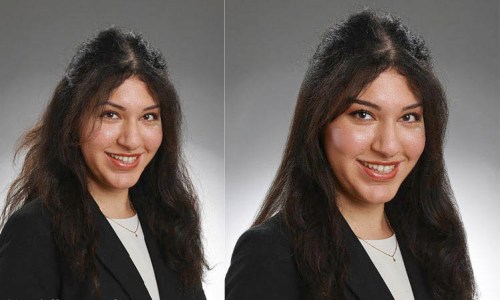
When using the Photoshop application without video or a script, the GENERATIVE FILL tool will do things like get rid of stray hairs in an image, which used to involve some complicated masking. Now, the tool will take care of it, and I have used it extensively in the last year or so. Here’s an example:
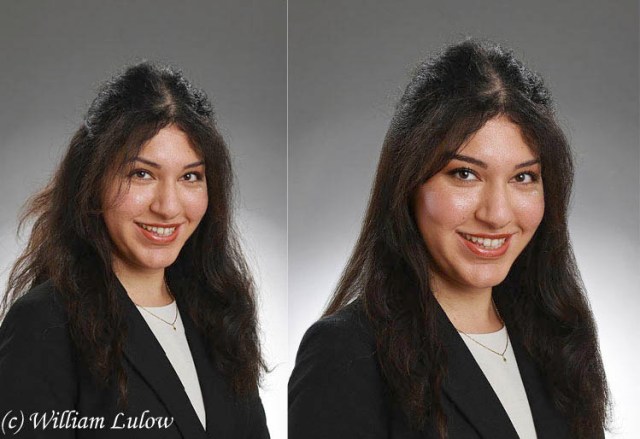
What I have found with a fair amount of trial and error, is that you have to know when to be specific with your commands (when the dialog box opens for your input) and when just to let the AI GENERATIVE FILL tool do it’s own thing. And, sometimes you need to work it a bit, like you do when you apply some standard retouching tools, and remove some unwanted details a bit at a time.
Again, AI can be a helpful tool but I’m still not sure it will replace humans, at least any time real soon. Maybe I’m behind the curve, but I can’t imagine something not human coming up with the motivation, let alone the creative intellect to start something completely from scratch with no human input whatsoever. Once it is given some basic instruction, it’s amazing what it can do. But if you’ve got a robot standing there, it’s hard to imagine that it will come up with some kind of idea about making an image all on its own without any human prompt whatsoever? I doubt it! Maybe I’ll be surprised while I am still working in this medium.
Discover more from William Lulow Photography
Subscribe to get the latest posts sent to your email.


